The short answer
Talk by phone before anyone meets your pet. Best Friends Animal Society suggests asking, in a conversational way, about the pets they have had and have now, who lives in the home, whether their pets are vaccinated, and where your pet will live. Ask for references and follow up on them. Meet in person (a walk together works well for dogs; meet in the adopter's home if they have cats) and watch how they and your pet respond to each other. Walk away from anyone who will not meet, wants the pet shipped, or pushes you to hurry. Be honest about your pet's needs, and finish with a signed contract.
LocalPetFinder is a directory, not a shelter or rescue. Shelter rules and fees change: each organization's own page has the current ones. The facts in this guide were checked against the cited pages on November 26, 2026.
Rehome your pet on LocalPetFinder, free
List your pet at no cost. They stay home until the right family is found, adopters message you through LocalPetFinder without seeing your email, and you choose who adopts. A person reviews every listing before it goes live.
You are in charge of where your pet goes. Best Friends Animal Society says it plainly: "you are in control of the situation and where your pet is placed. Don't be afraid to ask for references and follow up on them." This guide turns that into steps, using the screening advice Best Friends gives owners, the scam warnings from the Better Business Bureau (BBB) and Humane World for Animals, and what the ASPCA has learned from shelter adoption policies. It applies to dogs and cats alike.
Screening is a conversation, not an exam
Careful does not have to mean hard. Shelters have found the same. The ASPCA says that in shelters, open adoption practices, which do not put up financial, social or other barriers, let more pets leave and find new homes than rigorous adoption applications and background checks do. Citing a 2009 study of cat adopters, it also says people who get a pet for "free" do not value it any less than those who pay a fee to adopt. Best Friends gives owners the same tone: ask your questions "in a conversational style, so it doesn't sound like you're conducting an interview."
What you are looking for is fit and honesty: a household that suits your pet's energy, health and history, and a person who answers straight and asks good questions back. Notice whether they ask about your pet's quirks, health and history, or only for a photo.
The questions to ask, and why each matters
Best Friends Animal Society suggests talking to each person on the phone before introducing them to your pet, which saves time for both of you. Its questions, with the reasons it gives, are below.
| Question | Why it matters |
|---|---|
| What best describes your experience with having a pet? | Tells you whether they need the basics on feeding, exercise, vaccines and vets (Best Friends' list) |
| How would you describe your household? | A shy pet may not suit a busy home or young children (Best Friends' example) |
| How many pets do you have, what kinds, and how old are they? | Best Friends suggests a meet-and-greet with their pets, and a talk about energy levels if, say, a kitten would join a senior cat |
| Are your pets current on their vaccinations? | Shows whether their pets get vaccines and yearly vet visits, which Best Friends calls important |
| What pets visit your home? | Best Friends suggests a meet-and-greet with any frequent animal visitor before adoption |
| Where will the pet live? | Best Friends warns that garages can hold hazards such as antifreeze |
| What sort of pet are you looking for, and how quickly do you expect it to adjust? | A chance to explain that settling in can take weeks to months (Best Friends) |
Questions and reasons from Best Friends Animal Society's rehoming guide. Add your pet's specific needs: other dogs, children, stairs, medication.
Screening adopters who find your pet on LocalPetFinder
If you list your pet on LocalPetFinder, the screening in this guide is yours to do: a person on our team reviews your listing, not the people who answer it. Each message is emailed to you with a link to the conversation, and you reply there while your own email address and phone number stay hidden. You choose who adopts.
- Start in writing, then call. Ask the first questions on the conversation page, and move to a phone call with the people whose answers fit.
- Let the listing do some sorting. An honest description, with the compatibility answers filled in, lets people who are not a fit step back early.
- Shipping is a walk-away sign. Listings may not offer shipping or delivery, so anyone who wants your pet sent without meeting it is a red flag.
- A fee does not screen. The optional rehoming fee, if you set one, is due when the pet goes home, after a meeting. The conversation, references and meeting do the screening.
- Close it out. Once you have chosen, mark your pet adopted from the link in our emails. Start a free listing.
Be honest first, so they can be honest back
Screening runs both ways. Humane World for Animals asks owners to share their pet's personality, how it gets along with people and other pets, its favorite and not-so-favorite things, and any medical or behavior issues, "so that potential new owners will have the information they need to determine if your pet would be a good fit." If your dog has bitten, Best Friends says adopters should be screened and "made fully aware of the behavior issues," and Golden Beginnings Golden Retriever Rescue, a Houston rescue, tells owners that "failure to share known bite history may have legal consequences."
An honest description also gives people who are not a fit the chance to step back early.
Red flags that mean walk away
Many of the pets marketed online do not exist, the BBB says, and some scams offer a "free" pet, then charge for transport and other costs. Those warnings apply to owners as well as buyers. Humane World for Animals' rule of thumb covers both sides: it is to "not deal with anyone who claims to be a distant buyer, seller or adopter."
- Will not meet in person or keeps putting off a call. The BBB's advice for buyers, to see the pet in person before money changes hands, works in reverse: meet the person before your pet changes hands.
- Wants your pet shipped to them, or offers to pay a transport company, without ever meeting it.
- Pushes you to hurry or tries to make you feel your pet will suffer if you wait. The BBB lists high-pressure tactics among scam red flags.
- Will not answer basic questions about their home and pets, or gives answers that change.
- Refuses references or gives contacts who never answer.
- Shows no interest in your pet's needs, history or health, only in getting it quickly.
Never hand over a pet to someone you have not met
The BBB says to see pets in person before paying any money, and Humane World for Animals warns of scams built around shipping a "free" pet. For a rehome, meet the adopter face to face, and complete the handover at a home. Our guide to rehoming a pet safely covers scams in detail.
References: who to ask, what to ask
Ask for references and actually call them; Best Friends says not to be afraid to follow up. Some rescues ask for a vet reference as well as personal ones. Samoyed Rescue of Texas, for example, asks adopters for a vet reference and two personal references. A personal reference who has seen the person with animals can tell you how they treat them day to day.
Keep the call short: how long they have known the person, whether they have seen them with pets, and whether they would trust them with their own. Listen for hesitation as much as for the words.
Meeting in person, and the home visit
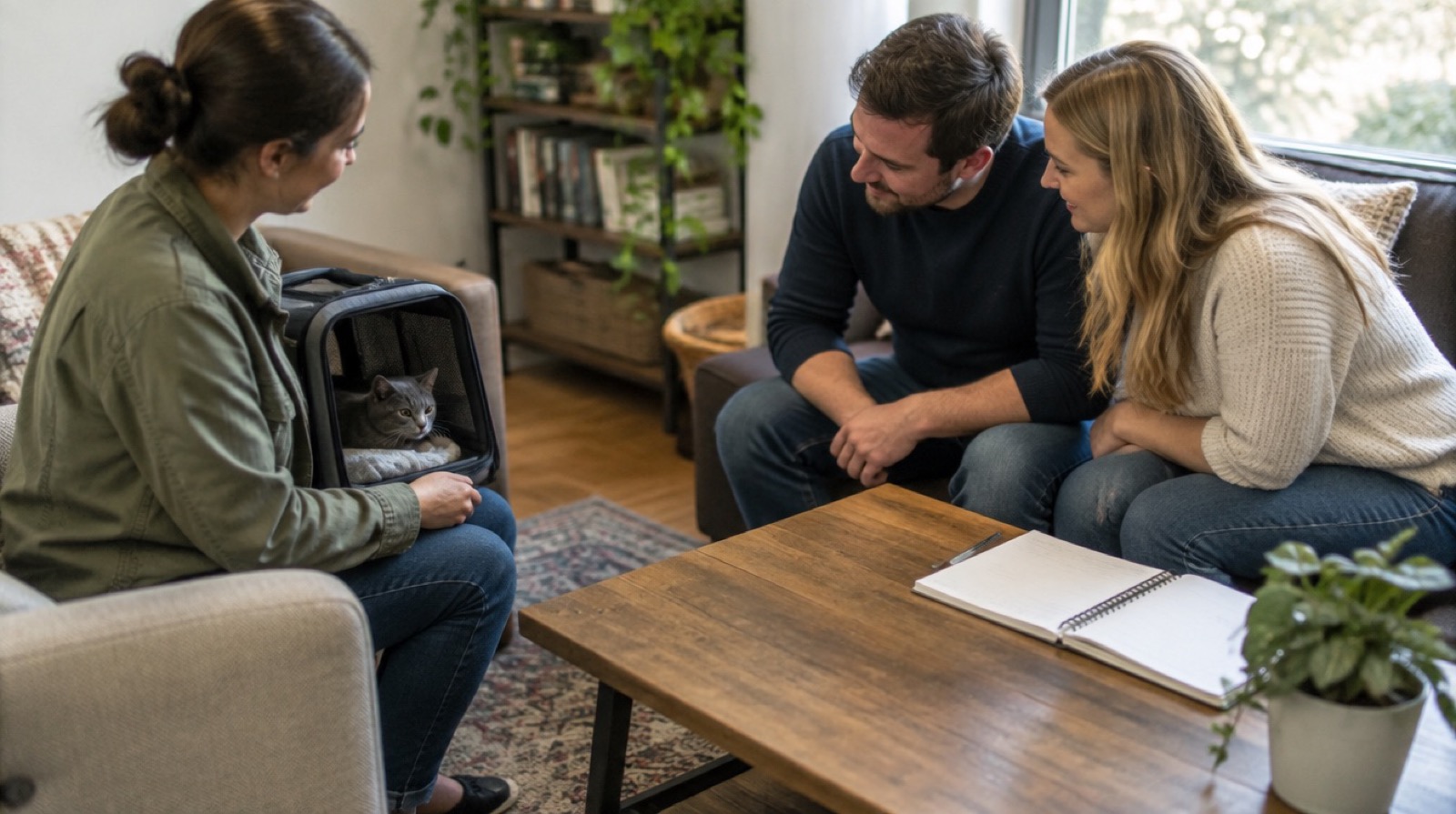
Best Friends Animal Society says the adopters could come to your place, you could take the pet to theirs, or you could meet on neutral ground such as a park or a vet's office. For dogs, "taking a walk with the dogs is a great introduction method." If the adopters have cats, it says meeting in their home is best. Either way, "observe closely how the people relate to the pet and how the pet relates to them."
A visit to the adopter's home lets you see where your pet will live: the fence and gates for a dog, windows and screens for a cat, and any other pets. Rescues use the same step; Samoyed Rescue of Texas's home visit focuses on the fence. If a visit is not practical, a video walk-through is a fallback, but the person should still meet your pet face to face.
Where the handover happens matters
Colorado has treated it as a class 2 misdemeanor since Aug. 6, 2025 (HB25-1180) to give away or offer a pet for adoption while the animal is somewhere public, such as a parking lot, park or street, at the moment it is transferred. Licensed facilities and a few other cases are exempt. Meet anywhere you like, but finish at a home.
Saying yes, saying no, and choosing between two
Saying yes. Confirm the plan in writing, then finish with an adoption contract. Best Friends calls it "a safety net for both you and the adopter": two copies, both signed, one each, with the medical and vaccination records and the pet's food, bowls, toys and bedding. Use the contract to agree on updates and on the adopter contacting you first if they cannot keep the pet. Our handover day guide has the full checklist.
Saying no. You do not owe a long explanation. A short, kind message works: thank them, say you have chosen a home that is a closer fit for your pet's needs, and wish them well. If you are unsure, it is fine to wait; Best Friends advises not to give up after just one or two interviews.
Two good adopters. Choose the closer match to your pet, not the faster yes: the household whose routine, other pets and experience fit what your pet needs. If it is still close, ask each how they would handle the problem your pet is most likely to bring.
Local dog surrender and rehoming guides
Each city guide compares how that city's shelters take in owned dogs, what they charge, and the help that can let you keep your dog.
Local cat surrender and rehoming guides
Each city guide compares how that city's shelters take in owned cats, what they charge, and the help that can let you keep your cat.
Frequently asked questions
Tap a question to expand
What questions should I ask someone who wants to adopt my pet?▼
Should I do a home visit before rehoming my pet?▼
What are red flags when rehoming a pet?▼
Should I ask for references?▼
Does charging a rehoming fee screen out bad adopters?▼
Do I have to tell adopters about my dog's bite history?▼
How do I say no to an adopter?▼
Does LocalPetFinder screen adopters for me?▼
More rehoming help
Guides for your situation
Why you are rehoming changes what to do first. Pick the guide that matches your situation, or start with the decision guide if you are still weighing it.
State rehoming guides
What the big shelters in each state ask at surrender, the help that may let you keep your pet, and the state law on giving up an animal.
Breed-specific rehoming guides
Rehoming a Husky is a different job than rehoming a Chihuahua. These guides cover the breed rescues worth contacting first and what adopters of each breed look for.